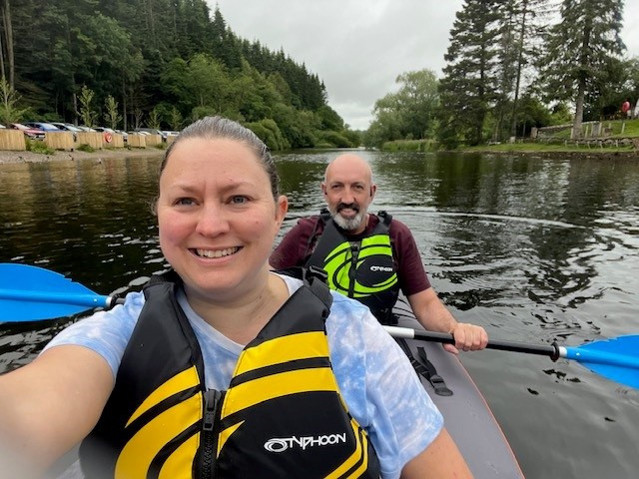
47-year-old Jodie Goulborn from Merseyside has a type of brain tumour called a glioma. A ground-breaking new drug called vorasidenib has been keeping it at bay for over 4 years, and now that drug is available on the NHS. It’s the first time a new adult brain tumour treatment has been approved in 20 years.
Jodie got the drug as part of the INDIGO trial, the results of which show that vorasidenib, which is taken once a day in pill form, has doubled progression-free survival – the average time it takes for the cancer to start growing again after starting on treatment – compared to a placebo.
Her cancer has remained stable since starting on the drug at the end of 2021. She’s had to have no further treatment, and being on the drug has meant that she’s been able to avoid having chemotherapy or radiotherapy.
“I’m so happy to hear that it’s now been approved on the NHS. I was actually one of the last people in the UK to be put on the trial, so to know now that other people will be able to have it means the world to me,” she says of the approval.
The drug is used to treat adults and children aged 12 years and older, with a grade 2 astrocytoma or oligodendroglioma with a susceptible isocitrate dehydrogenase mutation (IDH1 or IDH2). To be eligible, patients must have had surgery but no chemotherapy or radiotherapy.
IDH enzymes play an important role in making energy for cells. When they are mutated, metabolic changes in the cell lead to the development of cancer. Vorasidenib blocks the mutated enzyme and may help slow or stop the cancer from growing. Around 80% of people with grade two gliomas have one of these mutations.
Jodie’s story
Jodie was diagnosed with a walnut-sized grade 2 glioma in 2016.
In addition to vertigo, her main symptoms were problems with her memory and factual recall. Jodie found that she was forgetting words and was struggling to make connections between things, which was very unlike her. She was sent for scans and tests and was diagnosed with a brain tumour.
“When I went into the MRI machine, there was only one person there, but when I came out, there were 7. I had guessed that something was wrong, but that was the moment I knew,” comments Jodie. “I had been taking on a lot at work, had just got my dream job, and we were in the middle of building our own house. Everything in my life was coming together, so to be diagnosed with a brain tumour amongst all that was devastating.”
Jodie had surgery at her local hospital in February 2017, but as the tumour was sitting on the part of her brain that controlled motor function, she had to be awake for the operation. The surgery was successful, and they managed to remove 85% of the tumour.
Her team monitored her closely after the operation, but a couple of years later, the tumour started to grow back, and she needed further treatment.
Jodie, who has been married to her husband John for 15 years, was advised that her only option was gruelling chemotherapy and radiotherapy, which comes with side effects and a lot of time spent in hospital. Jodie, who has claustrophobia and would have had to wear a mask for her radiotherapy, really didn’t want this form of treatment, so she asked to be referred to The Christie for a second opinion.
Jodie, who has 4 cats and loves nature, was able to avoid radiotherapy and chemotherapy by going on the INDIGO trial at The Christie.
The trial started out double-blinded, meaning neither Jodie nor her team knew which drug she was on, but it met its primary endpoints 18 months early and was unblinded. It turned out that she had been on the trial drug the whole time.
Of her experience, Jodie says: “For the first while, I had to go to The Christie every 2 weeks for check-ups, but then it went to monthly quite quickly after that, which was great,” comments Jodie. “I still come in for tests and motor function tests, but being able to take one pill at home, rather than having to come in every day for treatment, made a massive difference.
“Before starting on the trial, both my physical and mental health were suffering. I was getting bad migraines and head pain in the area where the tumour was sitting. Obviously, that was stopping me from doing the things I loved, but I was also constantly worried about what was going on. I couldn’t stop thinking about it. It didn’t take long after being on the trial that the pain disappeared and the migraines decreased in frequency.”
The difference that the drug has had on my physical and mental health has been remarkable. I recently started a new job in the Probation Service and would never have had the confidence to do that if it wasn’t for the trial. It’s changed me as a person.
Jodie Goulborn, Christie patient
What the experts say
Professor Catherine McBain, Jodie’s Consultant Clinical Oncologist at The Christie, and Principal Investigator of the trial, comments: “The fact that this drug has been approved for use on the NHS – the first new approval in 20 years - is truly brilliant news for patients and their families. It’s a huge development.
“Jodie’s experience is a great example of what that means to patients. For many people, starting vorasidenib means that tumours that were steadily growing on follow-up scans stop growing and remain stable. The drug has very few side effects, and people can stay on it long-term, for as long as they are tolerating it and benefitting from it. This means that people can continue their normal family and working lives and delay the need for radiotherapy and chemotherapy, which can cause significant side effects.
“As with all cancer treatments, everyone’s experience is different and unfortunately, not everyone will have the same response. There are many different types of brain tumours, and vorasidenib is not the right treatment for everyone. However, this approval means that if it is the right treatment for you, we can now offer it to you routinely.
"We hope that by continuing to do clinical trials like INDIGO we might see desperately needed breakthroughs in treatment for other types of brain tumours.”
Professor Tina Karabatsou, Consultant Neurosurgeon and Clinical Lead for Neurooncology at Salford Royal Hospital, part of the Northern Care Alliance NHS Foundation Trust, said: “The neurosurgical and neuro-oncology teams work very closely together to ensure we are offering the best possible treatments to our patients. Advances in brain surgery mean that surgery for low-grade gliomas has improved dramatically over the years; the introduction of vorasidenib capitalises on that and provides a breakthrough in keeping low-grade gliomas under control and maintaining wellbeing and quality of life.”