
The Christie thymic team
- Dr Yvonne Summers – Consultant medical oncologist
- Dr Maggie Harris – Consultant clinical oncologist
- Dr Anna Moss – Clinical research fellow
- Sister Marie Eaton – Cancer specialist nurse
This team is supported by consultants from surgery, pathology, radiology, neurology, immunology and respiratory departments.
What is the thymus?
The thymus is a gland in the chest, behind the breastbone (sternum). It is part of the immune system; making the white blood cells (lymphocytes). These cells help fight infection.
The thymus is largest during childhood and the teenage years. As people get older, it becomes smaller and is slowly replaced by fatty tissue.
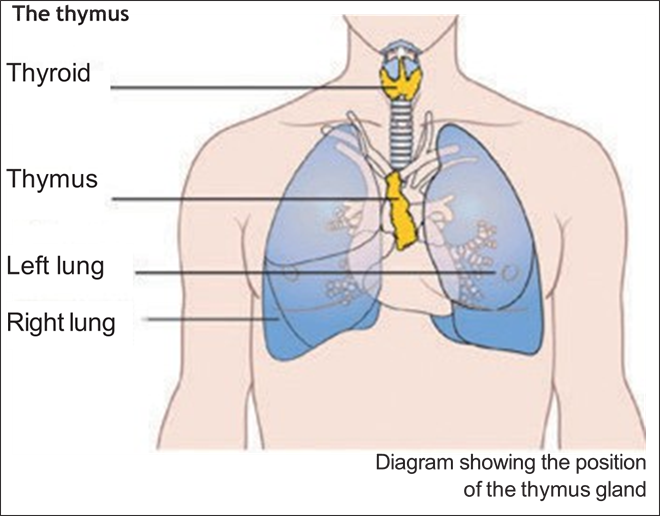
What are thymic epithelial tumours?
Thymic epithelial tumours are rare and the cause is unknown. They occur when cancer (malignant) cells form on the outside surface of the thymus.
There are 2 types of thymic epithelial tumours: thymoma and thymic carcinoma.
Thymoma
The tumour cells in a thymoma look similar to the normal cells of the thymus, grow slowly, and rarely spread beyond the thymus. They can vary in how they behave and grow more quickly, sometimes spreading to the lungs or the lining of the lungs (pleura). It is very unusual to spread anywhere else in the body.
Thymic carcinoma
The tumour cells in a thymic carcinoma look very different from the normal cells of the thymus. They tend to grow more quickly and have usually spread to other areas of the body before the cancer is found.
What are the signs and symptoms of a thymic epithelial tumour?
Thymoma and thymic carcinoma may not cause early signs or symptoms. They may be found by chance when having a chest X-ray or scan for something else.
If you do have symptoms, they might include:
- Chest pain
- A cough that doesn’t go away
- Shortness of breath
- Difficulty swallowing
- Hoarse voice
- Swelling of the neck or face
- Tiredness
Some symptoms may not be due to the cancer itself. They could be caused by an autoimmune disease related to the thymic gland cancer. An autoimmune disease happens when the immune system attacks healthy tissue and organs.
Autoimmune diseases are more commonly linked with thymomas than thymic carcinomas. One of the most common autoimmune diseases associated with thymic epithelial tumours is myasthenia gravis. Symptoms of this could be drooping of the eyelids, speech problems or difficulty swallowing. This is because myasthenia gravis causes muscles to become tired and weaken easily.
What tests will I need?
- Physical examination and history-taking
- Blood tests
Thymus gland cancers are quite often found by accident when having a chest X-ray. If the chest X-ray appears abnormal, you will be sent for more detailed imaging.
These may include:
- A computerised tomography (CT/CAT) scan: uses X-rays and a computer to create detailed pictures of the inside of the body. A dye may be used to help the organs or tissues show up more clearly.
- Magnetic resonance (MRI) scan: uses a magnet, radio waves and a computer to make a series of detailed pictures of inside the body.
- Positron emission tomography (PET) scan: uses a small amount of radioactive glucose (sugar) that can be detected in tumour cells as the scanner rotates around the body. Malignant tumour cells appear brighter then normal cells.
Doctors may need to take tissue samples (biopsy) from your thymus gland. This is to help with diagnosis and guide management. A biopsy can be taken in different ways. It may be taken before or during surgery.
The tissue sample will be viewed by a pathologist (specialist doctor) under a microscope to classify the type of cancer and help to stage the thymic tumour.
Has my cancer spread?
Staging is a way of describing the size of a cancer and if it has spread. When doctors first diagnose a cancer, they carry out tests (imaging, blood tests and biopsies) to check how big the cancer is and whether it has spread into surrounding tissues.
Thymoma
- Stage 1: Called a non-invasive thymoma. This means it has not spread beyond the thymus.
- Stage 2: The thymoma invades beyond the capsule (outer boundary of the thymus) and into the nearby fatty tissue or to the pleura (outer covering of the lung).
- Stage 3: The thymoma extends into the neighbouring tissues or organs of the lower neck or upper chest area, including the pericardium (covering of the heart), the lungs, or the main blood vessels leading into or exiting from the heart.
- Stage 4A: The thymoma has spread widely throughout the pleura and/or pericardium.
- Stage 4B: The thymoma has spread to distant organs.
Thymic carcinoma
Because thymic carcinomas are so rare, no universal staging system has been developed for them. Some doctors use the Masaoka staging system for thymic carcinoma as well as for thymomas.
Can I have treatment?
Your treatment will depend on the type of thymic epithelial tumour, its stage (how far it has spread) and as well as your general health.
Surgery
Surgery aims to remove all or as much of the cancer as possible. If the cancer has spread outside of the thymus gland the surgeon may also need to remove nearby areas of tissue and lymph nodes (small, bean-shaped organs which produce and store blood cells that help fight disease and infection). The way the surgeon removes the cancer will depend on the size and stage of disease.
Chemotherapy
Chemotherapy uses anti-cancer (cytoxic) drugs to destroy cancers cells throughout the body. It is given through a vein (IV/ intravenously).
It may be used to shrink the tumour before you have surgery. It may be the main treatment that you receive if surgery is not an option.
Radiotherapy
Radiotherapy uses high energy X-rays to destroy cancer cells, while doing as little harm as possible to healthy cells. It may be given after surgery to reduce the risk of the cancer coming back.
Radiotherapy may be the main treatment if surgery is not an option and this can be with or without chemotherapy. It is given in small daily doses (called fractions) usually over 5 to 6 weeks (Monday to Friday, not at weekends).
Clinical trials
You may be invited to take part in a clinical trial to help identify new treatments. However, this type of cancer is rare and there is not always a suitable trial available.
What is my prognosis?
A prognosis is the likely outcome of a disease or illness. It determines how likely you are to recover and predicts how your condition is likely to develop over time.
Thymic epithelial tumours generally have a good prognosis. This can depend on a number of different factors:
- The stage of the cancer
- The type of cancer
- Whether the tumour can be removed completely with surgery
- A patient’s general health
- The response to chemotherapy or radiotherapy if needed
Your doctor or nurse will talk this through with you.
We recognise that a diagnosis of cancer can be a life-changing event but would encourage you to continue with your usual day-to-day routine. We want you to feel supported both mentally and physically, and welcome you to contact us with any problems during your treatment and follow up.
Stopping smoking
We strongly advise you to stop smoking as we know that patients with thymic epithelial tumours are at increased risk of other cancers. Please ask us or your GP for advice or contact our smoking cessation team at The Christie on 0161 956 1215 or 07392 278408.
After your treatment
After your treatment has finished, you will have regular check-ups at the hospital for up to 10 years.
These appointments may include:
- talking about how you have been feeling and any symptoms you may have
- a physical examination
- blood tests
- scans, such as a chest X-ray or CT scan
People with thymic tumours may have a higher chance of developing other cancers or immune system conditions. It is important to attend any cancer screening appointments that you are invited to.
If you have any concerns or notice any new symptoms before your next appointment, please contact your doctor or nurse as soon as possible.
Helpful contacts
- Sister Marie Eaton, advanced practitioner 0161 918 2595
- Dr Summers’ secretary 0161 446 8016
- Dr Harris’ secretary 0161 446 3302
- The Christie Hotline (if you are unwell or require urgent medical advice): 0161 446 3658 (24 hours a day, 7 days a week)
- Smoking cessation at The Christie 0161 956 1215 or 07392 278408
Further information
- Macmillan Cancer Support helpline: Call free on 0808 808 0000 (8am to 8pm, 7 days a week). Staffed by trained experts, offers people with cancer and their loved ones practical, clinical, financial and emotional support. www.macmillan.org.uk
- Foundation for Thymic Cancer Research: A charity providing support to patients with thymic cancers, their carers, families and friends.www.thymic.org
- Maggie’s: Maggie’s provides free practical, emotional and social support to people with cancer, their families and friends