Flu levels across the North West

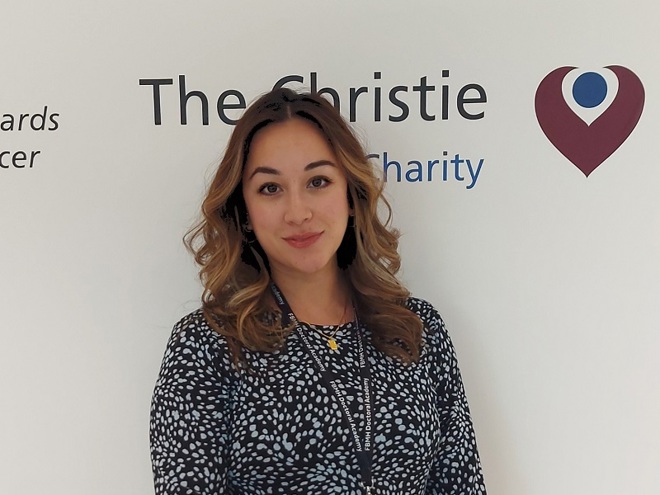
Lucy Davies, radiographer

Each and every person who works at The Christie performs a valuable role which directly links to patient care. Whether it is a nurse delivering chemotherapy treatments, a member of the administration team sending out an appointment letter, a surgeon performing a robotic procedure, the domestic teams ensuring our wards are spotlessly clean, or an IT engineer keeping our computer systems running, there is a huge variety of roles that come together to make The Christie special.

All our staff go to tremendous lengths to help each and every one of our patients and together: We are The Christie.

When Lucy Davies, one of our radiographers, was a teenager, she thought her future would be about performances and pointe shoes rather than radiotherapy and PhDs.

Lucy, who trained as a professional ballet dancer, has worked as a radiographer at The Christie for over 12 years. She’s now doing research that aims to minimise facial deformation in children who have had radiotherapy, including proton beam therapy, for head and neck cancer.

“I started dancing when I was 3 and then after my GCSEs I successfully auditioned for and trained at the Central School of Ballet in London,” she says. “I danced professionally for a while after graduating, but after sustaining an injury, I decided to retrain.
I wanted a career where I was able to help people whilst combining science and working with advanced complex technology, so radiotherapy seemed like the perfect choice.

Lucy Davies, radiographer

Lucy has always worked in paediatric radiotherapy and oncology. She has recently secured a prestigious NIHR Doctoral Clinical Academic Fellowship, looking at understanding facial deformation after radiotherapy, a life-altering long-term side effect of treatment in children with head and neck cancer.

“I’ve just completed the first year of my PhD. I've been working closely with my dedicated patient advisory group to develop a research study (the REFLECT study) aiming to better understand the experiences and perspectives of childhood cancer survivors and their families living with facial deformation after head and neck radiotherapy. REFLECT has recently opened for recruitment.

"I have also worked with experts from across the world to develop an international facial structures delineation consensus atlas so that we can tell which parts of the face will be receiving radiation during treatment. This will allow us to look at ways to try and reduce radiation dose to the facial structures that can lead to deformation during treatment planning.

“This is an area that hasn’t really been researched before, and we hope that the research will potentially improve outcomes for childhood cancer survivors.”

Watch our We are The Christie video on our YouTube channel to see some of our key services and the support offered at The Christie, as well as patients discussing how this has helped them.

A photo of Lucy Davies, specialised therapeutic radiographer in research at The Christie.