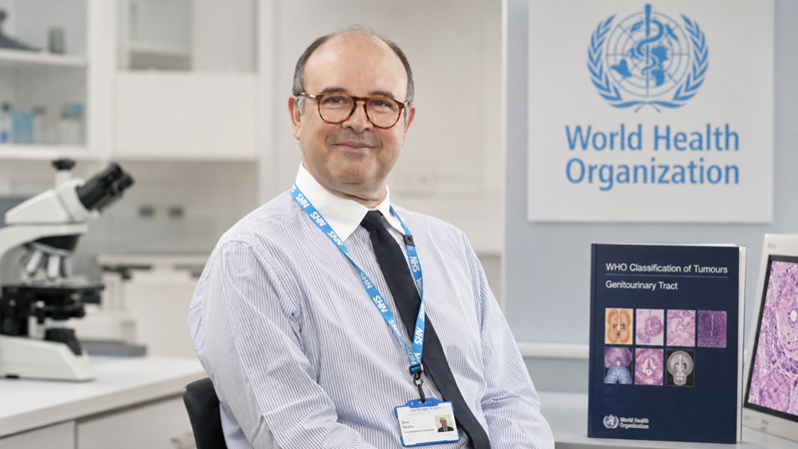
The Christie penile cancer service is pleased to share that Dr Pedro Oliveira, Consultant Genitourinary Pathologist at The Christie, has been invited to contribute to the new 6th edition of the World Health Organization Classification of Tumours: Genitourinary Tract.
The WHO Classification of Tumours is one of the most important international reference works used by pathologists, cancer specialists and researchers around the world. It helps define how tumours are classified, described and understood, ensuring that clinicians use consistent terminology when diagnosing and treating cancer.
As part of this work, Dr Oliveira will be a co-editor for the section on adenosquamous carcinoma of the penis, a rare form of penile cancer.
I am honoured to contribute to the new WHO Classification of Tumours in this rare area of penile cancer. Accurate pathology is central to understanding each patient’s cancer and helping the clinical team plan the most appropriate treatment. For rare tumours such as adenosquamous carcinoma of the penis, international collaboration is particularly important so that we can improve consistency in diagnosis, support education, and continue to build knowledge that ultimately benefits patients.
Dr Pedro Oliveira, Consultant Genitourinary Pathologist at The Christie
Dr Oliveira is a specialist pathologist with expertise in cancers of the urinary and male genital tract. At The Christie, he plays a central role in the diagnosis and assessment of penile cancer, working closely with surgeons, oncologists, radiologists, clinical nurse specialists and other members of the supraregional penile cancer multidisciplinary team.
He is also responsible for the Royal College of Pathologists dataset for penile cancer. This dataset helps ensure that penile cancer pathology reports across the UK include the key information needed to guide treatment, predict risk, support research and improve consistency of care for patients.
Accurate classification of penile cancer is important because not all penile cancers behave in the same way. The exact type of tumour, its depth of invasion, grade, surgical margins, lymphovascular invasion and other microscopic features can influence decisions about surgery, lymph node assessment, radiotherapy, chemotherapy and follow-up.
For patients, this means that expert pathology is a key part of receiving the right treatment plan. The pathology report does not simply confirm a diagnosis. It provides essential information that helps the multidisciplinary team understand how a cancer is likely to behave and what treatment or surveillance may be needed.
Adenosquamous carcinoma is an uncommon subtype of penile cancer. Because rare tumours are seen less frequently, international collaboration and expert consensus are especially important. Contributions to the WHO Classification help clinicians in different countries use the same language when diagnosing and describing these cancers. This supports clearer communication between teams, improves education, and helps build a stronger evidence base for rare tumour types.
For The Christie penile cancer service, Dr Oliveira’s invitation reflects the strength of the specialist multidisciplinary team and the importance of expert pathology within the patient pathway. Penile cancer is rare, and patients benefit from care in centres where there is experience in diagnosis, treatment planning, complex surgery, oncology, lymph node management, reconstruction, rehabilitation and long-term support.
The Christie penile cancer service continues to work closely across surgery, pathology, radiology, oncology, nursing and research to provide specialist care for patients with penile cancer and related conditions. This recognition of Dr Oliveira’s expertise highlights the vital role pathology plays in every patient’s diagnosis and treatment journey.